Friday, January 15, 2010
Resisting conductivity
Thursday, July 2, 2009
I want a RIDE.
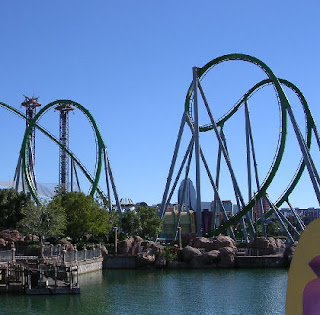
The Roller Coaster:How does a roller coaster work?
What you may not realize as you're cruising down the track at 60 miles an hour is that the coaster has no engine. The car is pulled to the top of the first hill at the beginning of the ride, but after that the coaster must complete the ride on its own. You aren't being propelled around the track by a motor or pulled by a hitch. The conversion of potential energy to kinetic energy is what drives the roller coaster, and all of the kinetic energy you need for the ride is present once the coaster descends the first hill..
Once you're underway, different types of wheels help keep the ride smooth. Running wheels guide the coaster on the track. Friction wheels control lateral motion (movement to either side of the track). A final set of wheels keeps the coaster on the track even if it's inverted. Compressed air brakes stop the car as the ride ends.
Newton's third law of motion comes into play on the bumper cars. This law, the law of interaction, says that if one body exerts a force on a second body, the second body exerts a force equal in magnitude and opposite in direction on the first body. It's the law of action-reaction, and it helps to explain why you feel a jolt when you collide with another bumper car.
How do bumper cars work?
Bumper car rides are designed so that the cars can collide without much danger to the riders. Each car has a large rubber bumper all around it, which prolongs the impact and diffuses the force of the collision.
The bumper cars run on electricity, carried by a pole on the back of the car that leads up to a wire grid in the ride's ceiling. This grid carries the electricity that runs the car. Electrical energy carried to the cars from the grid is converted to kinetic energy, some of which is converted to heat.
What happens to the drivers?
When bumper cars collide, the drivers feel a change in their motion and become aware of their inertia. Though the cars themselves may stop or change direction, the drivers continue in the direction they were moving before the collision. This is why it's important to wear a seat belt while driving a real car, since otherwise you could suffer injury being thrown forward in a collision.
The masses of the drivers also affect the collisions. A difference in mass between two bumper car riders will mean that one rider experiences more change in motion than the other (or more of a jolt). The type of collision, velocity of the cars, and mass of the individual drivers all come into play in bumper car collisions.
The Pendulum Ride:Pendulum rides are a little like the swing sets you might remember from your childhood. Swings give you a feeling of flying in a controlled manner. You pump your legs to provide enough force to increase the height of the swing's arc, and enjoy the increased velocity of the downward swing. When you stop pumping, the swing gradually slows and then stops.
What causes the feeling of "weightlessness" on pendulum rides?
Riders often experience near-weightlessness as they approach the top of a pendulum ride. If the ride is the type that makes a complete 360-degree circle, they experience a feeling of complete weightlessness.
Feelings of weightlessness are not due to a decrease in forces of gravitation; people do not feel forces of gravity. What you feel is the force of a seat (or other external object) pushing on your body with a force to counteract gravity's downward pull. A 180-pound person at rest in his office chair experiences the seat pushing upwards on his body with a force of 180 pounds. Yet at the top of a pendulum ride, the same 180-pound person will feel less than this normal sensation of weight. At the very top of the pendulum ride, riders begin to fall out of their seats. Since a 180-pound person is no longer in full contact with his seat, the seat is no longer pushing on him with 180 pounds of force. Thus, the rider has a sensation of weighing less than his normal weight.
Why do riders experience high g-forces on pendulum rides?
As riders pass through the bottom of the circular arc, they often experience high g-forces. Once again, these g-forces are not evidence of increasing forces of gravitation, but the result of increases in the amount of force applied by the seat upon their bodies. Understanding this demands a little information about circular motion.
The motion of an object in a circle requires that there be a force directed toward the center of the circle (sometimes called a "centripetal force"). This means that at the bottom of the circular swing, there must be an upward force (since the circle's center is upward). Gravitational forces are always directed downward upon a rider's body; thus, gravitational forces cannot meet this centripetal force requirement. The seat must supply the centripetal force, pushing upwards on the rider with a force greater than gravity's downward pull. For a 180-pound person, the seat might have to supply 360 pounds of upward pull. This is twice the usual amount experienced by our 180-pound rider. For this reason, we would say the rider experiences 2 g's of force (a seat force that is 2 times the gravity force).
For more Amusement Park Physics. Click Here.
Wednesday, July 1, 2009
Nobel Prize Winners in Physics (1901-1920)
1901:
1902:
1903:
Discovery of spontaneous radioactivity Joint researches on the radiation phenomena discovered by Professor Henri Becquerel

Investigations of the densities of the most important gases and for his discovery of argon in connection with these studies

Optical precision instruments and the spectroscopic and metrological investigations carried out with their aid
Development of wireless telegraphy.

Invention of automatic regulators for use in conjunction with gas accumulators for illuminating lighthouses and buoys.

Investigations on the properties of matter at low temperatures which led, inter alia, to the production of liquid helium.
The analysis of crystal structure by means of X-rays
1917:
Nobel Prize in Physics: Most Famous Recognition for a Physicist
Who is Alfred Nobel?
Alfred Bernhard Nobel (Stockholm, Sweden, 21 October 1833 – Sanremo, Italy, 10 December 1896) was a Swedish chemist, engineer, innovator, armaments manufacturer and the inventor of dynamite. He owned Bofors, a major armaments manufacturer, which he had redirected from its previous role as an iron and steel mill. In his last will, he used his enormous fortune to institute the Nobel Prizes. The synthetic element nobelium was named after him.
The AwardThe Nobel Prize in Physics consists of a gold medallion (the Nobel Prize Medal for Physics), a diploma, and a monetary grant. The Nobel Prize Medals, which have been minted in Sweden since 1902, are registered trademarks of the Nobel Foundation. Their engraved designs are internationally-recognized symbols of the prestige of the Nobel Prize.
This recognition is, as considered, the highest form of achievement for every physicist. One with the most outstanding research and discovery beneficial to the community can be nominated for this award.
Nomination and Selection
A maximum of three Nobel Laureates and two different works may be selected for the Nobel Prize in Physics. Compared with some other Nobel Prizes, the nomination and selection process for the Nobel Prize in Physics is long and rigorous. This is a key reason why these Nobel Prizes have grown in importance over the years to become the most important prizes in Physics.
These Nobel Laureates are selected by a committee that consists of five members elected by The Royal Swedish Academy of Sciences. In its first stage, several thousand people are asked to nominate candidates. These names are scrutinized and discussed by experts until only the winners remain. This slow and thorough process was insisted upon by Alfred Nobel.
Forms, which amount to a personal and exclusive invitation, are sent to about three thousand selected individuals to invite them to submit nominations. The names of the nominees are never publicly announced, and neither are they told that they have been considered for the Prize. Nomination records are sealed for fifty years. In practice some nominees do become known. It is also common for publicists to make such a claim, founded or not.
The nominations are screened by committee, and a list is produced of approximately two hundred preliminary candidates. This list is forwarded to selected experts in the field. They remove all but approximately fifteen names. The committee submits a report with recommendations to the appropriate institution.
While posthumous nominations are not permitted, awards can occur if the individual died in the months between the decision of the prize committee (typically in October) and the ceremony in December. Prior to 1974, posthumous awards were permitted if the recipient had died after being nominated.
The Nobel Prize in Physics requires that the significance of achievements being recognized is "tested by time." In practice it means that the lag between the discovery and the award is typically on the order of 20 years and can be much longer. For example, half of the 1983 Nobel Prize in Physics was awarded to Subrahmanyan Chandrasekhar for his work on stellar structure and evolution that was done during the 1930s. As a downside of this approach, not all scientists live long enough for their work to be recognized. Some important scientific discoveries are never considered for a Prize, as the discoverers may have died by the time the impact of their work is realized.
Note: The full article can be viewed here.
Tuesday, June 30, 2009
Physical Quantity
When we measure a quantity, we always compare it with some reference standard. This standard defines a unit of quantity. The meter is a unit of distance and second is a unit of time.
Here are some unit conversion factors.
LENGTH:
1km = 1000m = 0.6214mi
1m = 3.281ft = 39.37in
1cm = 0.3937in
1in = 2.540cm
1ft = 30.48cm
1yd = 91.44cm
1mi = 5280ft = 1.609km

1 nautical mile = 6080ft

TIME:1min = 60s
1h = 3600s
1d = 86,400s

Sample Problem:
Converting speed unit: The official world land speed record is 1228.0 km/h, set on October 15, 1997, by Andy Green in the jet engine car Thrust SSC. Express this speed in meters per second.
Solution:
Since we already know that
1km = 1000m and 1h = 3600s, then we can now directed solve the problem.
So we write,

where km/km = h/h = 1, the only unit left are m and s. Then we have,
.In my next post, I'll be writing on unit conversion for AREA.
Introduction

This blog is a tribute to the subject that caused me huge trouble. Nah, just kidding. Seriously, I created this blog as a tool for students who, in ways, have the same interest as I am. I'll be posting some physics question with solution that may help some people having difficulties with physics but mainly I'll be discussing general information on Physics.
I'll also be posting some funny jokes bout physics because you see, physics has also it's humor you know.
To let you know more about physics, it's quite necessary to enumerate the aspects that is categorized under this broad subject. Trust me, this is more than just velocity, gravity and magnets. Yeah, yeah... Einstein.
The Categories:
• Chemical Physics - the study of physics in chemical systems
• Computational Physics - the application of numerical methods to solve physical problems for which a quantitative theory already exists
• Cosmology - the study of the universe as a whole, including its origins and evolution
• Cryophysics / Cryogenics / Low Temperature Physics - the study of physical properties in low temperature situations, far below the freezing point of water
• Crystallography - the study of crystals and crystalline structures
• Electromagnetism - the study of electrical and magnetic fields, which are two aspects of the same phenomenon
• Electronics - the study of the flow of electrons, generally in a circuit
• Fluid Dynamics / Fluid Mechanics - the study of the physical properties of "fluids," specifically defined in this case to be liquids and gases
• Geophysics - the study of the physical properties of the Earth
• High Energy Physics - the study of physics in extremely high energy systems, generally within particle physics
• High Pressure Physics - the study of physics in extremely high pressure systems, generally related to fluid dynamics
• Laser Physics - the study of the physical properties of lasers
• Mathematical Physics - applying mathematically rigorous methods to solving problems within physics
• Mechanics - the study of the motion of bodies in a frame of reference
• Meteorology / Weather Physics - the physics of the weather
• Molecular Physics - the study of physical properties of molecules
• Nanotechnology - the science of building circuits and machines from single molecules and atoms
• Nuclear Physics - the study of the physical properties of the atomic nucleus
• Optics / Light Physics - the study of the physical properties of light
• Particle Physics - the study of fundamental particles and the forces of their interaction
• Plasma Physics - the study of matter in the plasma phase
• Quantum Electrodynamics - the study of how electrons and photons interact at the quantum mechanical level
• Quantum Mechanics / Quantum Physics - the study of science where the smallest discrete values, or quanta, of matter and energy become relevant
• Quantum Optics - the application of quantum physics to light
• Quantum Field Theory - the application of quantum physics to fields, including the fundamental forces of the universe
• Quantum Gravity - the application of quantum physics to gravity and unification of gravity with the other fundamental particle interactions
• Relativity - the study of systems displaying the properties of Einstein's theory of relativity, which generally involves moving at speeds very close to the speed of light
• Statistical Mechanics - the study of large systems by statistically expanding the knowledge of smaller systems
• String Theory / Superstring Theory - the study of the theory that all fundamental particles are vibrations of one-dimensional strings of energy, in a higher-dimensional universe
• Thermodynamics - the physics of heat
See, there are so many amazing things about physics. Ah oh, I guess polymer physics just emerge after a huge discovery of conducting polymers. Kindly correct me if I'm wrong.